Monday, February 23, 2015

#17 Apple plans public betas for iOS 8.3 and iOS 9

Apple plans to release iOS public betas for testing iOS 8.3 and iOS 9 ahead of global launch.


Apple is planning to launch a public beta program to eliminate bugs from upcoming iOS versions ahead of their general releases. The company will roll out iOS 8.3 betas in March and iOS 9 beta in summer, according to reports.


Apple had come under fire for the lack of quality control in iOS 8. The launch of the iOS beta program will ensure that the OS is more reliable and widely tested by consumer launch.

According to reports, Apple will open the iOS public beta builds for the first 100,000 users who sign up. Apple will release the upcoming iOS 8.3 as a public beta through the AppleSeed program in mid-March. The iOS 9 are expected to be unveiled at the Worldwide Developer Conference in June, with a public beta release during the summer, ahead of a fall release.

iOS 8.3 codenamed 'Stowe', is expected to bring Apple's as-yet-unnamed music streaming service, based on Beats Music that the company acquired last year. Apart from that iOS 8.3 will also bring in support for Wireless Car Play and a new image keyboard. 

The iOS 9 codenamed 'Monarch' is expected to be primarily focused on bug fixes and stability issues. It may also bring in new features like transit directions and indoor modes to the mapping service.


Last year, Apple had provided 1 million people a chance to test OS X Yosemite ahead of its launch. Since then the Cupertino firm has offered public betas to users for minor OS X updates as well.


Apple plans to release iOS public betas for testing iOS 8.3 and iOS 9 ahead of global launch - See more at: http://www.digit.in/mobile-phones/apple-plans-public-betas-for-ios-83-and-ios-9-25362.html#sthash.AaUIxNnU.dpuf
Apple plans to release iOS public betas for testing iOS 8.3 and iOS 9 ahead of global launch. - See more at: http://www.digit.in/mobile-phones/apple-plans-public-betas-for-ios-83-and-ios-9-25362.html#sthash.AaUIxNnU.dpuf

#16 3 easy steps for maximum performance for your Android emulator (Intel HAXM)


First time users of Intel® HAXM can occasionally run into situations where they are not sure if their Android* emulator is in fact using HAXM technology. This article will provide the necessary steps to verify that you are in fact using HAXM technology.

Once you have Intel® HAXM for Android emulator installed on your system, the next step is to create an appropriate Android* Virtual Device (AVD) configuration using the x86 Android* images for the target API level.  We need to ensure the x86 image has already been downloaded inside the Android SDK manager.

For example, for Android* "L" preview, open your Android SDK Manager and ensure the x86 image for "L" preview is installed.


Next, open the Android AVD Manager (located in android-SDK folder), create a new AVD configuration with the CPU set to x86 as shown/highlighted below.


Now, when you start this AVD configuration, you will see an indication that HAXM is working in a separate window with message "HAX is working and emulator runs in fast virtual mode". Please see below.


Sometimes, you may not see this message confirming HAXM is working. This could be related to situations where there is a delay in showing the window/status. For example, if you choose to use a host camera in your AVD configuration, it will open another window asking you to pick which of the host cameras, which can delay the HAXM status message (or not show at all).

At any time, you can always run "sc query intelhaxm" in a command prompt (shown above), to check the current status of HAXM. The STATE should show "RUNNING" (shown in above screenshot).
In summary, even if you do not see the status "HAX is working...", you can ensure you are using HAXM by checking the items below:
 Make sure you are creating the AVD with an x86 image. AVD manager will not show the x86 option if you did not download those specific API level x86 images in SDK manager.

Open a cmd prompt and run "sc query intelhaxm" for current status of HAXM. The STATE should say "RUNNING".


For an additional sanity check, once you have your emulator started, go to the Windows Task Manager, and look for a process nameemulator-x86. ex. If you do not find it, and instead find emulator-arm. exe, double check that your ad configuration is set to x86 as discussed.


You can always visually see the difference in performance with HAXM and without. It is unmistakable.

#15 15 Sci-Fi movies that scored big at the Oscars


It’s a well known secret that if you, as a filmmaker, never want to win a Best Movie Oscar, then you should make a science fiction film. Yes, sci-fi as a genre has often been disrespected and ignored by the Academy that awards the Oscars, something made unflinchingly clear by the fact that incredible movies like 2001: A Space Odyssey, Star Wars and Blade Runner were never adjudged the best movie of the year that they came out, even though they deserved it. On the other hand, sci-fi movies generally rule the stage when it comes to visual effects or sound design at the Oscars.
So, let’s take a look at the science fiction movies that did well at the Oscars over the years.


Gravity (2013)

 
By far the most successful sci-fi movie at the Oscars, Gravity was responsible for a whitewash at last year’s Oscars, winning 7 awards, including Best Director for Alfonso CuarĂ³n and Best Cinematography for Emmanuel Lubezki. The movie about a pair of astronauts, played by Sandra Bullock and George Clooney, stranded in earth’s orbit after their craft is destroyed, also won Oscars for film editing, original score, sound editing, sound mixing and visual effects while being nominated for best picture, best actress for Bullock and production design.


Star Wars (1977)


Well, what can we say about Star Wars that you don’t already know? The movie responsible for spawning the most successful and profitable sci-fi franchise of all time was a big damn deal when it was released in 1977, winning six Oscars for art direction, costume design, film editing, original score, sound, and visual effects while missing out on Oscars for best supporting actor (Alec Guinness), best director and original screenplay (George Lucas), and best picture.


E.T. the Extra Terrestrial (1982)


Trust Steven Spielberg to make a children’s movie that was so good that it’s now recognised as one of the best movies of all time. E.T., ripped off by Bollywood movie Koi Mil Gaya in 2003, revolved around the relationship between a kid and a friendly alien who crash lands on earth. E.T. won four Oscars for original score, sound, sound effects editing and visual effects and lost out on best director for Spielberg and best picture only because Richard Attenborough’s Gandhi was nominated the same year.


Inception (2010)


Chances are if Inception hadn’t set the box office on fire, the Academy would have ignored it, despite the fact that it was one of the more intelligent and the riskiest movies of the year. The movie, written and directed by Christopher Nolan, is about a group of thieves who can reach into people’s dreams and steal their secrets. The movie ended up winning four Oscars for best cinematography, sound editing, sound mixing and visual effects and lost out on Oscars for best picture, original screenplay, art direction and original score.


Terminator 2: Judgement Day (1991)


If you were to ascertain the most influential filmmaker of the modern era based on both box office earnings and Oscar wins, one name would rise to the top. Yup, James Cameron is not only responsible for some of the most memorable movies of all time, but also for earning buckets of cash for studios. Cameron’s Terminator 2: Judgement Day is considered as one of the best action movies of all time and stars Arnold Schwarzenegger in his prime as a robot tasked with protecting a boy and his mother from a robot assassin sent back from the future. T2 won four Oscars
in 1992 for best makeup, sound, sound editing and visual effects while it lost the Oscars for cinematography and film editing.


The Matrix (1999)


The Matrix is one of the most significant sci-fi movies of the modern era and is a work of striking imagination from the filmmaking duo of Andy and Lana Wachowski. Responsible for kick-starting the Matrix franchise, it is known for its inventive design and effects, both of which would influence hundreds of other filmmakers around the globe. Despite its seminal nature, the Matrix was only nominated in four categories, film editing, sound mixing, sound editing, and visual effects, all of which it won.


Jurassic Park (1993)

 
Anyone who was a kid in 1993 had their mind blown by this movie and its bestiary of animatronic and CGI dinosaurs. Spielberg’s Jurassic Park was based on the novel of the same name by popular sci-fi author Michael Crichton and won all three Oscars that it was nominated for- best sound editing, sound mixing and visual effects.


Avatar (2009)


The highest grossing movie of all-time, Avatar is a visual effects spectacle that is single-handedly responsible for bringing 3D movies into the mainstream. The avatar is also in a lot of aspects, an old-fashioned science fiction tale that takes viewers into a fantastical alien world while telling a simple yet well-realised story. The avatar was nominated for nine Oscars in 2010, out of which it won for best art direction, cinematography and visual effects.


20,000 Leagues Under the Sea (1954)


Based on the popular Jules Verne novel, 20,000 Leagues is the oldest movie in this list. The movie is well known for its great effects and design and audiences at the time were enthralled by a battle involving a giant squad. It won two Oscars in 1954 for art direction and special effects and was also nominated for best film editing.


Fantastic Voyage (1966)


Another classic, Fantastic Voyage is about a group of scientists who get themselves shrunk in order to save another scientist’s life from a blood clot. The movie was received well by critics and did well at the box office as well. It ended up winning two Oscars for art direction and special effects in 1966.


The Empire Strikes Back (1980)


Generally considered to be the best Star Wars movie and one of the finest science fiction movies ever made, the Empire Strikes Back revels in both its fantastical sci-fi universe, but also a darker, grimmer tone that sets the stage for the conflicts that would define the Return of the Jedi. TESB is rightly known for the way it helps Darth Vader, Luke Skywalker, Han Solo and Princess Leia evolve into the cult characters that everyone loves today. The film was nominated for four Oscars out which it won two for sound mixing and visual effects but shockingly, it wasn’t nominated for best picture.


Cocoon (1985) 


The cocoon is about a group of aliens disguised as humans who form a relationship with elderly people living in a retirement home. Directed by Ron Howard, who would later win an Oscar for directing for A Beautiful Mind, Cocoon was a big hit when it was released and won two Oscars, including a rare acting Oscar when Don Ameche was adjudged best supporting actor, and another one for visual effects.


Aliens (1986)


If Alien, the 1979 film, was all about silence and the absolute blackness of space, its 1986 sequel was on fire and blood and how man behaves when he (and she) comes across something unbelievably malignant. If you watch Aliens, another Cameron film, today, you’ll realise that the movie hasn’t aged; its visual effects still look good and its characters behave in ways that still feel ‘modern’. And then, there’s the Alien, a celluloid creature that has inspired countless other creatures in movies, games and books. Nominated for seven Oscars, including best actress for Sigourney Weaver, the film won two for sound effects editing and visual effects.


Apollo 13 (1995)

 
Unlike the other films in this list, Apollo 13 isn’t science fiction; instead, it’s science docudrama that chronicles the struggles of three astronauts aboard the failed Apollo 13 moon mission in 1970. Starring Tom Hanks, Kevin Bacon and Bill Paxton and directed by Ron Howard, the movie was both a critical and a commercial success. It was nominated for nine Oscars and won two for film editing and sound.


The Dark Knight (2008)

 
Although it has been beaten in box office earnings by other superhero films and was followed by an utterly disappointing sequel, there is no way that we can overstate the importance and the quality of the Dark Knight and the performances (or rather, THE performance) it engendered. The Dark Knight was nominated for eight Oscars and won two, including, of course, the posthumous best supporting actor nod for Heath Ledger, and another for sound editing. Predictably, it lost the best picture award to the inferior Slumdog Millionaire.

Sunday, February 22, 2015

#14 15 mobile trends that should be big in 2015

We may be just two months into 2015, but the year already shows a lot of promise for emerging smartphone trends. We expect things to really pick up with the Mobile World Congress, to be held in Barcelona in a few weeks. The smartphone industry may not see something revolutionary this year, but 2015 will definitely set the stage for big innovations to come. Here's a low down on all the emerging trends that should become big by the end of the year.


AMOLED over IPS..
What used to be a Samsung thing at one time, has now been adopted by a lot of manufacturers. Companies like Motorola, Microsoft and even Micromax are capitalising on the rich colours of the AMOLED display and more should do so by the end of the year.


Edges and Curves..Samsung and LG are spearheading this movement, with the Galaxy Note Edge and the G Flex 2 respectively. It is only a matter of time before other manufacturers decide to take a shot at these technologies. 


Plastic OLED
LG's plastic OLED is a mouth watering proposition. If done right, the concept could take over displays everywhere. They're tougher to break and easier to manipulate. They're suitable not just for smartphones, but for wearables and other devices as well. Best of luck LG!


Li-Polymer Batteries..
More and more smartphones today come with Lithium Polymer batteries. They're lighter and slimmer, allowing for today's slim and light designs. Yes, you do compromise on battery life, but a lot is being done on that front through the software side of things.


Size zero..
Speaking of slim designs, that's another trend that should pick up. It's not one that we're particularly fond of, but that's only because manufacturers tend to overdo it. The slim Galaxy Alpha and iPhone 6 is a treat to use, though, while Gionee, Vivo and Oppo have taken things to a whole new level, dropping the thickness of smartphones to as little as 4.75mm.


4K Videos..This is already a trend. While the Xperia Z3 offers 4K recording, just like the Note 4, the latter can even take 4K videos using the front camera. We'll be damned if the newer flagships don't have such features as well.


64-bit
Apple may have done this first, but Android is bringing it to the mainstream. The lollipop is a 64-bit OS and Qualcomm's newest 64-bit processors are showing a lot of promise. Also, Samsung just announced its own 64-bit octal-core chipset in the Exynos 7. Let's hope the Snapdragon 810 issues are truly behind us though.


16GB minimum..
Let's face it, if a phone is going to record 4K videos and take high-res images, then it must have enough storage space. Hence, we expect 16GB to be the minimum internal storage for any smartphones. Of course, the MicroSD slot is still a must, especially with the better SD card support that Lollipop promises.


Metal and stuff..
It's not just metal bodies that are going to be big, but manufacturers should be experimenting with different materials this year. The One Plus One has a nice sandstone finish on the back, while Motorola's wooden books are a treat as well. On top of that, Samsung has brought metal to the affordable segment now. See where this is going?


Selfies..
Yes, we aren't fond of this trend, but let's face it, it's here to stay. The front camera is getting bigger and selfie sticks should be sold by the dozen by the end of the year. Even Barack Obama has 'endorsed' the selfie strike now!


2K displays..
Have you seen the displays on the Galaxy Note 4 and Note Edge? Well, if other manufacturers can replicate those, then 2K may very well be worth putting on a smartphone. It's a trend, manufacturers would want to capitalise on, even though the human eye can't discern the difference on such a small screen.


Phablets are back..
If 2K is to become a thing, then you need bigger screens. Both Google and Apple have joined the fabled brigade now and these big screen devices are officially mainstream. Well, it's ok with us, as long as they still keep making good compact smartphones as well.


Doing away with bezels..
Speaking of compact phones, phablets can only be so big, before they become irrelevant. The best way to do that is by dropping the bezels from your smartphones. Sharp was one of the first to do this and the Aquos Crystal does look quite amazing.


Faster internet..
You must have noticed how Samsung just launched 4G versions of three of its existing devices. Plus, the Lenovo A6000, Yu Yureka and Xiaomi Redmi Note 4G are all 4G capable devices below Rs. 10,000. What does this tell you? That 4G is here to stay and the powers that be want to make it available for the cheapest of devices.


Speak up..
Last but not the least, the big three all have their own voice assistants now. Google has Google Now, Apple is still working with Siri and Microsoft is taking big strides with Cortana. It's a battle of the voice assistants and one that is really interesting, since it opens up a lot of avenues for smartphones to get better. In fact, every mobile device can benefit from better voice-related features.

#13 Intel Curie: The Brain for low-cost, low-power wearables


Last year this month Intel's CEO Brian Krzanich introduced the world to the Intel Edison chip. This year he is introduced to us the Intel Curie, a button sized module using the Intel Quark SE SoC designed for wearables.


Curie is designed to be efficient at always on applications in form factors such as rings, bags, fitness trackers, and shoes to name a few.  


The Intel Curie module includes:

 Low power, 32-Bit Intel Quark microcontroller 384kB flash memory and 80kB SRAM 6-Axis accelerometer and gyroscope
 Battery charging circuitry (PMIC) Intel has created a software kit for wearable technology called Intel IQ. This software kit has been created to help developers and companies create fast wearable applications using Intel technology by including device, software, software for smartphone applications, cloud software and analytics capabilities. Currently they have released two software kits called Intel Body IQ and Intel Social IQ.


Intel Body IQ has a range of capabilities to name a few Intel Body IQ has algorithms and functions for counting steps, calculation of calories burned daily, visual device notifications for the status of the user. Intel Social IQ a few functions include device-to-device single state communication, notifications for user designated calls, SMS, social network notifications, and cloud portal for device companies to push brand notifications.


The Intel Curie module should come as no surprise to people as Intel has been putting a strong emphasis onto wearable technology in fitness and clothing with products and initiatives such as: 


 Basis Peak
 

 Fossil Group
 

 Luxottica Group
 

 MICA bracelet
 

 SMS Audio
 

 Intel Wearable Challenge
 

 Intel Vice President and GM of Intel's New Devices Group, Mike Bell, was quoted saying "In the future, we will see wearable products created by companies that have historically never used silicon before… It’s now up to the ecosystem to innovate with this technology; rings, bags, bracelets, pendants and yes, buttons, will all be possible."

Intel Curie is slated for release in the second half 2015.

Saturday, February 21, 2015

#12 App of the Week: Frankly.Me

Frankly.Me is an app that allows users to ask questions to celebrities, who then answer through video selfies.

 This week’s app of the week, Frankly. Me, has the potential to become much more than it currently is. It will take the app time to achieve the said potential, but you can definitely see why it could be useful. You'll find the app under the name 'Talk To Celebrities, Frankly', on your app store.
The app was originally created to form a communication channel between the general public and celebrities from different arenas. Frank. Me has names like Arvind Kejriwal, Javed Akhtar, Kiran Bedi and many more right now. Also, in lieu of the ICC Cricket World Cup 2015, the app has brought in Jatin Sapru, sports presenter and commentator.

 Android version of the app


Frankly. Me allows users to pose questions to the celebrities who are available on the app. The celebrities then respond to these questions through video selfies of themselves. In addition, you also have the option to like, share and comment on the answers that celebrities have posted. Furthermore, there’s WhatsApp integration that allows you to share stuff with friends from the app.


iOS version of the app


Another reason for liking Frankly. Me is the interface. The app has a simple yet good looking design. While it obviously looks good on high-end phones, Frankly. Me seems to have paid a lot of attention to the low end smartphones as well. The app runs reasonably smoothly on a budget device, with minimal lags and stutters. There is a slight stutter when you're on the search screen, but not enough to hate the app. 

What Frankly. me needs to work on is getting bigger name celebrities into the app and increasing interaction between users. The social network element needs to pick up and that can only be achieved if the resources are spent towards getting more people to sign up. The idea is very new, especially for a country like India, but it has a lot of potential if done the right way. Lastly, the categories for the celebrities needs to be increased.For example, while Jatin Sapru has been added to the World Cup, there is no section that lets users check only for sports personalities. Of course, that's possibly because there aren't enough sports personalities on the app yet, but even otherwise, there aren't enough categories. You will categories like Actors, Politicians, Authors, Chefs, Singers, Radio Jockeys, Entrepreneurs, New on Frankly, Trending Now and Subject Experts. A lot of these sections don't have many big names either, which we hope will be added later.
The app is currently available on Android and iOS.

Friday, February 20, 2015

#11 WhatsApp starts testing voice calling feature with select users

WhatsApp has reportedly rolled out the voice calling feature to users through invitation only. 


Mobile messaging service WhatsApp has reportedly started rolling out the much awaited voice calling feature to users in India through invitation only. The feature is restricted to Android users with the latest version 2.11.508 of the messenger app.


WhatsApp is reportedly testing the feature and is rolling it out slowly. The new feature is accessible to users only after they receive an invitation from others using the feature. So even if you download the latest version of the app on your device, you will have to wait for someone to roll it out for you or call you. An edit user first reported the new voice calling feature on his Nexus 5 device running the latest Android lollipop OS.


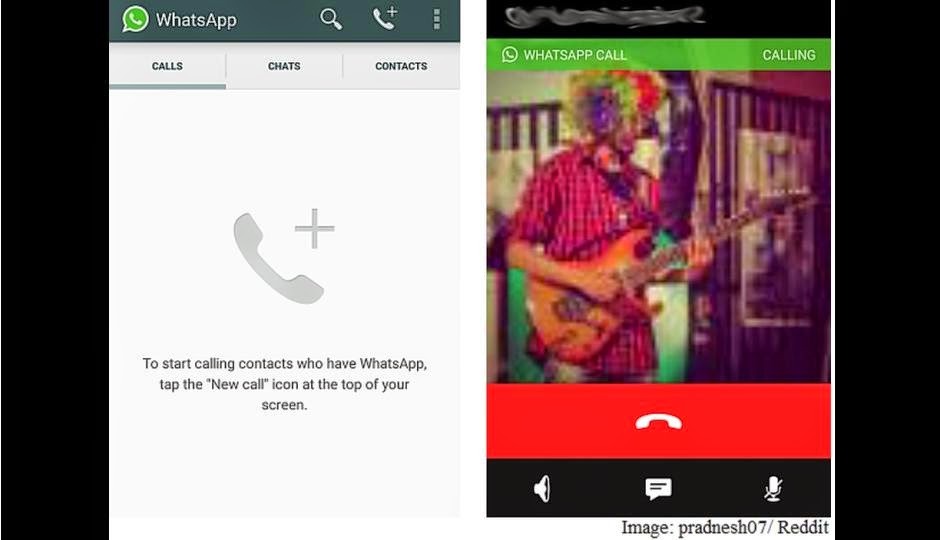
The screen shots posted by the Reddit users show a new Calls tab along with Chats and Contacts. Users who get the invitation for the future will be able to see a standard calling interface, with the disconnect button above buttons for speaker, messages, and mute. The call interface is fairly simple, showing the name and WhatsApp image of the person you are calling. 

He posted saying that, “I can’t seem to send invites to other people, the only thing I can ensure is that it works in India for people running Lollipop 5.0.x on a Nexus 5. Other Indians without the earlier combo don’t get it.” 


The UI seen in the images is similar to the earlier screenshots released in December of the voice calling feature. WhatsApp has not announced the feature officially as yet, as the company may be looking for some feedback before launching a global release of the feature. 


WhatsApp which has over 700 million users globally has been rolling out new features to further its reach. The messaging app recently announced WhatsApp through the desktop web browser and end to end chat encryption for Android users.

WhatsApp is evidently competing with the likes of Viber and Hike, which also offer voice calling feature. Voice calling through messaging apps have gained popularity over the years. However, the telecom operators in India have raised concerns over the voice calling feature, and have even sought revenue share. 

Nokia C1 renders leak ahead of launch, hints at 4GB RAM and dual rear cameras

Is Nokia working on its own AI assistant for smartphones? Nokia is planning its return to the smartphone industry with two new flagshi...